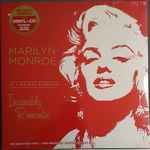
Fabulous Marilyn Monroe
★ 5.00
1 ocen
1 ma
1 chce
Rok
0
Kraj
France
Format
Vinyl
LP, Compilation
Label
Marquis Disque
50-50103
Non-MusicPopStage & Screen Spoken Word
Identyfikatory
Matrix / Runout: MARQUIS DISQUE 50-50103 A CC
Matrix / Runout: MARQUIS DISQUE 50-50103 B CC ?
Tracklista
A
Harlow
B
Monroe
Notatki wydania
"Marquis Bisque" typo on front cover. Disque in runouts
Never On LP Before. Personal Performances.
There are, in the male lexicon of females, many categories, many areas of pulchritude ticketed to titillate the libido, tickle the fancy and turn on the turnee.
Varied as the male taste is there is one area that remains high on the list....blondes. Doesn't matter the size, shape, situation. Men have gone batty for blondes since Eve, who was probably a blonde, gave Adam the apple.
On this LP we have a pair of blonde aces, back There is Jean Harlow, the sizzling sexpot of the post-silent film era in Hollywood and her clone, some twenty or so years later, Marilyn Monroe. They were so alike that the Hollywood hucksters used them as the source of the same quotes without noting that originally, Mae West said all those things.
No matter. Gentlemen prefer blondes, as the lady wrote and most of the time they were not gentlemen. It was the talent of La Harlow and La Monroe that they could change gentlemen into heels and heels into souls. The smooth, suave society snob, as well as the bounder and the cad, were reduced to rubble by the blast of a blonde batting her eyes, among other things, at them.
There is a segment here from an early film with Cary Grant, the venerable elder statesman of sex, who, with Clark Gable---did anyone ever notice they have the same initials?---appears with both our leading ladies on this epic. Grant sings a bit here and does a much better job than his somewhat odd representation of Cole Porter on the screen. That wasn't as bad as, say, casting W.C. Fields as a temperance union leader but it wasn't much better.
One of the classic screen bits of them all, Harlow's seduction of James Cagney in the vintage years for both of them, runs long here to the syrupy backdrop of violins running through "I surrender, Dear." Whilst she hugs Cagney to her ample bosom, thereby coming damn close to smothering him, she delivers some of the wildest lines in the history of screenwriting. She winds it up with, "You don't give, you take. Tommy, I could love you to death!" They don't write them like that
anymore.
The comic side of Harlow, and she had a fine talent here, is shown as she hides Clark Gable in a closet and tells her sugar daddy, who drops in on this one, that she is smoking cigars for her health. She is nervous, and dig how she pronounces that one, but loses any pretense when Gable lunges into the picture. She and The King just about jump out of the grooves, as they just about jumped off the screen.
With Wallace Beery, he of the gravel voice, Jean does a fine "dumb blonde" mimic and you get the
idea she may have acted out more than one scene with her tongue in her cheek. Harlow was not just a good
looking broad, although the qualities of a good looking broad will take a girl far, indeed. She had a presence on the screen and knew it, as you can gather here from her exchanges with Spencer Tracy, Walter Pidgeon, and Bill Powell.
Harlow concludes with a bit of song, "Reckless," and she rendered the tune well, although her movie assignments did not include musicals.
Marilyn Monroe, on the other hand, bounced in and out of several musicals and she could handle a song capably. Her acting was a source of much discussion and debate over the years and perhaps it can be said of her that she might have role, off the screen that is, much too seriously. Harlow gloried in the role of a sex symbol and you could tell that she knew it was a crock of spit. Marilyn thought....well, no matter. Neither of them, it is figured, were that happy with their private lives and that's a pity. They had much and earned much.
There's a nice exchange to open Miss Monroe's side, some laughs with Charlie McCarthy and even an appearance by Ray Noble who wrote
"Cherokee." much older on this side, still the brash and tough fellow who was adored by the ladies and admired by the men.
"I thought about getting married," he rasps, "but never in the daylight." A classic line. Gable was a guy always at home with the broads, in full command of the battle of the sexes.
Grant's appearance with Monroe shows his madcap style of later years and Marilyn's ability to meet it and play off it. She also sings about
filing her claim with the deathless question, "Are You Looking For Nuggets?" Then there is the venerable Charles Coburn and we even have Charles Laughton leering at her for a time.
Marilyn could ask the question, in all innocence, "who wouldn't want to meet a man with millions who isn't even bald?" She could get away with that and also parry funnies with Bill Lundigan and with Jack Paar as well as playing against the veteran Barbara Stanwyck who notes "home is where you come when you run out of places." A thought-provoking sentiment, indeed.
Marilyn wraps it up by getting herself caught between the menacing moves of Robert Ryan and the fumbling middle-age of Paul Douglas. She was at home here as the femme fatale.
There are, have been and will be some classy looking ladies on the screen but few will ever match the heights of Harlow and Monroe.
They were blondes right down to their toenails and they could prove it, too.
– Gaylord Tremaine
Master release
Wszystkie wydania ↗
Brak dopasowania Spotify dla tego artysty.
Szukaj na Spotify →